




Acrich LEDs
Acrich LEDs are high-voltage LED solutions that can be operated directly with alternating current. They support AC mains voltages of 50/60 Hz and operating voltages from 6 V to 230 V. The elimination of AC/DC converters and patented multi-junction technology enable compact, efficient, and cost-effective LED systems.
|
|
|||||||||||||||||||
|---|---|---|---|---|---|---|---|---|---|---|---|---|---|---|---|---|---|---|---|
| Seoul Semiconductor | MJT3030 | Cool White | 6500 K | 80 | 31831 mcd | 100 lm | 106 lm/W | 0.94 W | 47 V | 20 mA | 120 ° | No | 3 mm | 3 mm | 0.65 mm | -40 °C | 100 °C | SMD 3030 | |
| Seoul Semiconductor | MJT3030 | Cool White | 5600 K | 80 | 31831 mcd | 100 lm | 106 lm/W | 0.94 W | 47 V | 20 mA | 120 ° | No | 3 mm | 3 mm | 0.65 mm | -40 °C | 100 °C | SMD 3030 | |
| Seoul Semiconductor | MJT3030 | Cool White | 5000 K | 80 | 31831 mcd | 100 lm | 106 lm/W | 0.94 W | 47 V | 20 mA | 120 ° | No | 3 mm | 3 mm | 0.65 mm | -40 °C | 100 °C | SMD 3030 | |
| Seoul Semiconductor | MJT3030 | Natural White | 4500 K | 80 | 31831 mcd | 100 lm | 106 lm/W | 0.94 W | 47 V | 20 mA | 120 ° | No | 3 mm | 3 mm | 0.65 mm | -40 °C | 100 °C | SMD 3030 | |
| Seoul Semiconductor | MJT3030 | Natural White | 4000 K | 80 | 31831 mcd | 100 lm | 106 lm/W | 0.94 W | 47 V | 20 mA | 120 ° | No | 3 mm | 3 mm | 0.65 mm | -40 °C | 100 °C | SMD 3030 | |
| Seoul Semiconductor | MJT3030 | Warm White | 3500 K | 80 | 31831 mcd | 100 lm | 106 lm/W | 0.94 W | 47 V | 20 mA | 120 ° | No | 3 mm | 3 mm | 0.65 mm | -40 °C | 100 °C | SMD 3030 | |
| Seoul Semiconductor | MJT3030 | Warm White | 3000 K | 80 | 31831 mcd | 100 lm | 106 lm/W | 0.94 W | 47 V | 20 mA | 120 ° | No | 3 mm | 3 mm | 0.65 mm | -40 °C | 100 °C | SMD 3030 | |
| Seoul Semiconductor | MJT3030 | Warm White | 2700 K | 80 | 31831 mcd | 100 lm | 106 lm/W | 0.94 W | 47 V | 20 mA | 120 ° | No | 3 mm | 3 mm | 0.65 mm | -40 °C | 100 °C | SMD 3030 | |
| Seoul Semiconductor | MJT3030 | Cool White | 6500 K | 80 | 36606 mcd | 115 lm | 122 lm/W | 0.94 W | 47 V | 20 mA | 120 ° | No | 3 mm | 3 mm | 0.6 mm | -30 °C | 100 °C | SMD 3030 | |
| Seoul Semiconductor | MJT3030 | Cool White | 5600 K | 80 | 36606 mcd | 115 lm | 122 lm/W | 0.94 W | 47 V | 20 mA | 120 ° | No | 3 mm | 3 mm | 0.6 mm | -30 °C | 100 °C | SMD 3030 | |
| Seoul Semiconductor | MJT3030 | Cool White | 5000 K | 80 | 36606 mcd | 115 lm | 122 lm/W | 0.94 W | 47 V | 20 mA | 120 ° | No | 3 mm | 3 mm | 0.6 mm | -30 °C | 100 °C | SMD 3030 | |
| Seoul Semiconductor | MJT3030 | Natural White | 4500 K | 80 | 36606 mcd | 115 lm | 122 lm/W | 0.94 W | 47 V | 20 mA | 120 ° | No | 3 mm | 3 mm | 0.6 mm | -30 °C | 100 °C | SMD 3030 | |
| Seoul Semiconductor | MJT3030 | Natural White | 4000 K | 80 | 36606 mcd | 115 lm | 122 lm/W | 0.94 W | 47 V | 20 mA | 120 ° | No | 3 mm | 3 mm | 0.6 mm | -30 °C | 100 °C | SMD 3030 | |
| Seoul Semiconductor | MJT3030 | Warm White | 3500 K | 80 | 36606 mcd | 115 lm | 122 lm/W | 0.94 W | 47 V | 20 mA | 120 ° | No | 3 mm | 3 mm | 0.6 mm | -30 °C | 100 °C | SMD 3030 | |
| Seoul Semiconductor | MJT3030 | Warm White | 3000 K | 80 | 36606 mcd | 115 lm | 122 lm/W | 0.94 W | 47 V | 20 mA | 120 ° | No | 3 mm | 3 mm | 0.6 mm | -30 °C | 100 °C | SMD 3030 | |
| Seoul Semiconductor | MJT3030 | Warm White | 2700 K | 80 | 36606 mcd | 115 lm | 122 lm/W | 0.94 W | 47 V | 20 mA | 120 ° | No | 3 mm | 3 mm | 0.6 mm | -30 °C | 100 °C | SMD 3030 | |
| Seoul Semiconductor | MJT5630 | Cool White | 6500 K | 82 | 17886 mcd | 52 lm | 118 lm/W | 0.44 W | 22 V | 20 mA | 115 ° | No | 5.6 mm | 3 mm | 0.75 mm | -40 °C | 85 °C | SMD 5630 | |
| Seoul Semiconductor | MJT5630 | Cool White | 5600 K | 82 | 17886 mcd | 52 lm | 118 lm/W | 0.44 W | 22 V | 20 mA | 115 ° | No | 5.6 mm | 3 mm | 0.75 mm | -40 °C | 85 °C | SMD 5630 | |
| Seoul Semiconductor | MJT5630 | Cool White | 5000 K | 82 | 17886 mcd | 52 lm | 118 lm/W | 0.44 W | 22 V | 20 mA | 115 ° | No | 5.6 mm | 3 mm | 0.75 mm | -40 °C | 85 °C | SMD 5630 | |
| Seoul Semiconductor | MJT5630 | Cool White | 6500 K | 82 | 17886 mcd | 52 lm | 118 lm/W | 0.44 W | 22 V | 20 mA | 115 ° | No | 5.6 mm | 3 mm | 0.75 mm | -40 °C | 85 °C | SMD 5630 | |
| Seoul Semiconductor | MJT5630 | Natural White | 4000 K | 82 | 17886 mcd | 52 lm | 118 lm/W | 0.44 W | 22 V | 20 mA | 115 ° | No | 5.6 mm | 3 mm | 0.75 mm | -40 °C | 85 °C | SMD 5630 | |
| Seoul Semiconductor | MJT5630 | Warm White | 3500 K | 82 | 17886 mcd | 52 lm | 118 lm/W | 0.44 W | 22 V | 20 mA | 115 ° | No | 5.6 mm | 3 mm | 0.75 mm | -40 °C | 85 °C | SMD 5630 | |
| Seoul Semiconductor | MJT5630 | Warm White | 3000 K | 82 | 17886 mcd | 52 lm | 118 lm/W | 0.44 W | 22 V | 20 mA | 115 ° | No | 5.6 mm | 3 mm | 0.75 mm | -40 °C | 85 °C | SMD 5630 | |
| Seoul Semiconductor | MJT5630 | Warm White | 2700 K | 82 | 17886 mcd | 52 lm | 118 lm/W | 0.44 W | 22 V | 20 mA | 115 ° | No | 5.6 mm | 3 mm | 0.75 mm | -40 °C | 85 °C | SMD 5630 |
Our
manufacturer
Brochures
Here you will find bundled information on the topic as well as selected brochures with further content, technical background information, and practical solutions.

Frequently asked questions about
Acrich LEDs
The questions on this page come from conversations with engineers designing a component in and with buyers who need to replace an existing type. They range from the basics to the details that show what really matters during selection. Whatever remains open we clarify for your specific case: tell us your target values – we narrow down the eligible series and give you price, availability and samples for your quantity.
02
How does multi-junction technology work in Acrich LEDs?
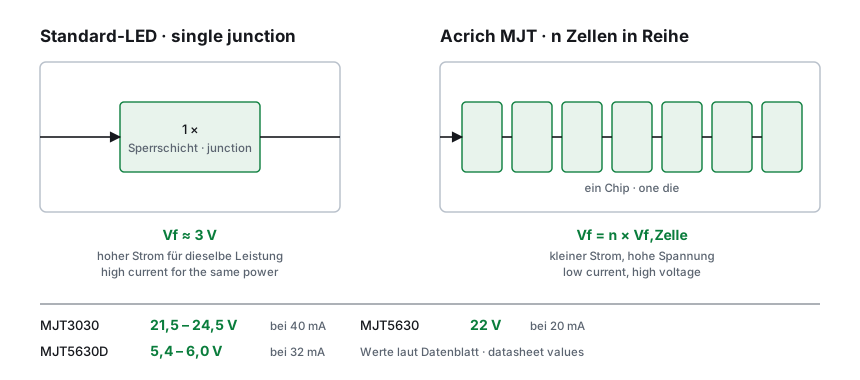
In multi-junction technology, several emitter cells sit in series on one chip instead of a single large junction. The forward voltage adds up across the cells, while the current for the same power drops accordingly. The datasheets show this directly:
- MJT3030: 21.5 to 24.5 V at 40 mA (SAW9C72A) or 45 to 50 V at 20 mA (SAW8CF2A)
- MJT5630 (SAW8KG0B): typically 22 V at 20 mA
- MJT5630D (SAW8Q24D): voltage bins from 5.4 to 6.0 V at 32 mA
The low current is the real lever: it reduces ohmic losses in tracks and driver, allows narrower conductors, and lets a manageable number of devices in series reach the rectified mains voltage. Because the series connection is formed on the die itself, it also removes many bond-wire and solder joints.
03
How do Acrich LEDs differ from standard LEDs with a switch-mode power supply?
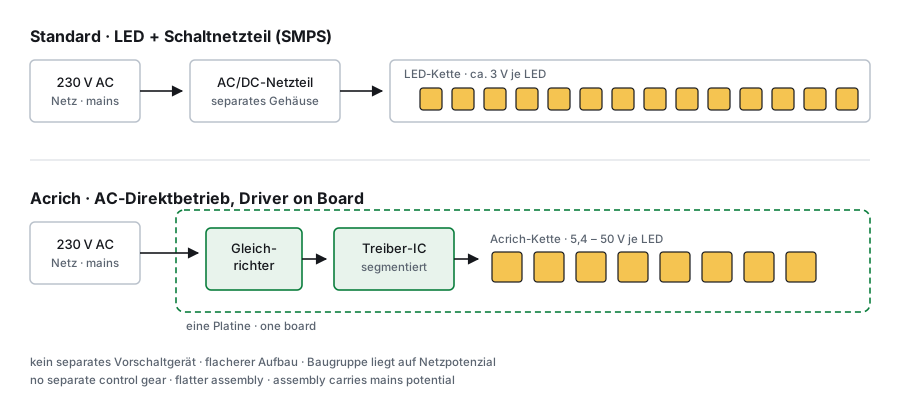
The difference lies in the power supply, not in how the light is generated. A standard LED at around 3 V needs a switch-mode power supply that steps mains voltage down to a low DC voltage; Acrich LEDs run in AC direct operation from the rectified mains, regulated by a switching driver that sits on the board itself ("driver on board"). For luminaire design this means:
- fewer external components and no separate driver enclosure
- flatter, lighter assemblies in which the light-emitting area and the electronics share one board
- but a luminous flux that follows the mains half-waves and, without countermeasures, ripples at twice the mains frequency
- dimming via leading- or trailing-edge phase control (LE/TE) or 0–10 V, as far as the chosen driver supports it
- power factor and harmonic distortion (THD) arise on your own board; Seoul quotes around 0.97 and below 15 % for Acrich system solutions
- an assembly that carries mains potential
04
Which Acrich series does the category cover and how do I choose the right one?
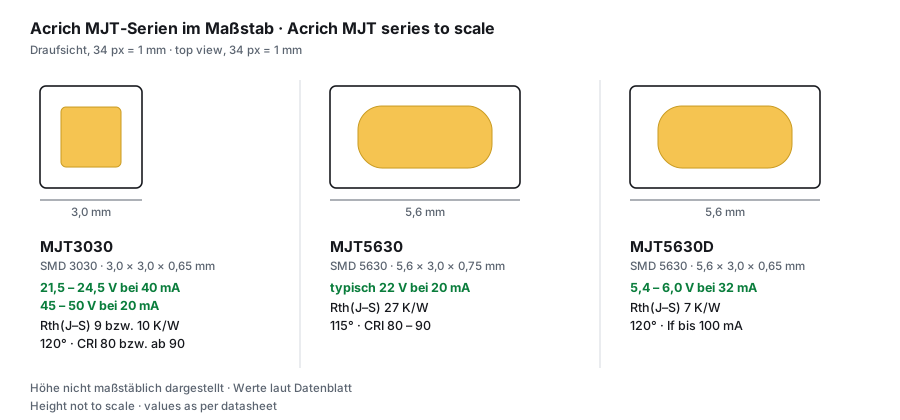
The category covers three MJT series that differ mainly in package, voltage class and thermal resistance:
- MJT3030 — SMD 3030, 3.0 × 3.0 × 0.65 mm, in two voltage classes: 21.5 to 24.5 V at 40 mA with Rth(J–S) 9 K/W and CRI from 90 (SAW9C72A), and 45 to 50 V at 20 mA with Rth(J–S) 10 K/W and CRI from 80 (SAW8CF2A); both 120° viewing angle
- MJT5630 — SMD 5630, 5.6 × 3.0 × 0.75 mm; typically 22 V at 20 mA, Rth(J–S) 27 K/W, 115°, CRI 80 to 90
- MJT5630D — SMD 5630, 5.6 × 3.0 × 0.65 mm; voltage bins 5.4 to 6.0 V at 32 mA, Rth(J–S) 7 K/W, 120°, current up to 100 mA
Selection starts with the voltage class, because it determines how many devices a string needs to reach the peak of the half-wave. The thermal budget decides next: 7 versus 27 K/W is almost a factor of four, which feeds straight through to junction temperature at the same power dissipation. Colour point, CRI and viewing angle narrow the choice last.
05
How many Acrich LEDs can be connected in series on a 230 V mains supply?
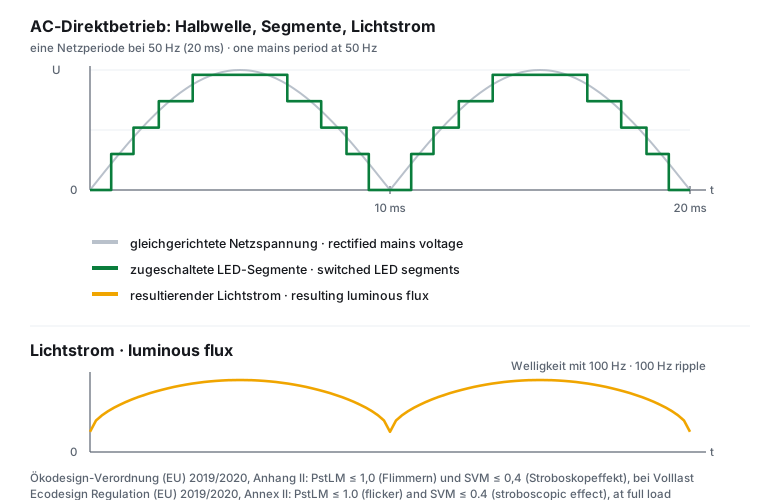
What matters is not the 230 V RMS value but the peak of the rectified half-wave at roughly 325 V. A string of devices rated 22 V each reaches that peak after about 14 LEDs; with the 45 to 50 V MJT3030 types, after roughly seven. A fixed string of that length would only light up near the top of the half-wave, however, because the instantaneous voltage sweeps from zero to the peak. This is exactly why Acrich drivers work in segments: they switch sub-strings in as the voltage rises, switch them out again, and hold the current constant in between. The actual number of LEDs per segment and per module is therefore a question of driver topology, not a fixed property of the component.
06
What does mains operation mean for layout, insulation and safety?
An assembly running directly on rectified mains carries mains potential and is no longer a SELV circuit — that shapes layout and testing more than the LED itself does. Points to cover:
- clearance and creepage distances to EN/IEC 60664-1 and the luminaire standards of the EN/IEC 60598 series, depending on overvoltage category and pollution degree
- insulation against the heat sink on metal-core boards, including the test voltage
- protection against contact, both installed and during servicing
- protection against reverse voltage: the driver circuit must apply forward voltage only, otherwise migration can damage the device
- the displacement factor (cos φ1) of the finished light source: Ecodesign Regulation (EU) 2019/2020 requires at least 0.5 from 5 W, 0.7 from 10 W and 0.9 from 25 W input power
Against electrical overstress the datasheets explicitly recommend surge protection and a current-limiting measure in the circuit.
07
How much do Acrich LEDs flicker in mains operation?
Without countermeasures the luminous flux follows the mains half-waves and ripples at twice the mains frequency — 100 Hz on a 50 Hz supply. How much of that stays measurable is decided by the driver, not by the LED. The binding reference is Ecodesign Regulation (EU) 2019/2020: for mains light sources using LED technology, PstLM ≤ 1.0 for flicker and SVM ≤ 0.4 for the stroboscopic effect have applied at full load since 1 September 2021 (Annex II, Table 4). What is assessed is the finished light source, not the individual component. Those values are reachable: Seoul quotes a flicker index below 0.12 for Acrich system solutions. Measuring the metrics only on the finished sample risks a luminaire that is photometrically convincing yet cannot legally be placed on the market.
08
How are Acrich LEDs designed in thermally?
Thermal design starts with the thermal resistance Rth(J–S), which is between 7 and 27 K/W across these series and is specified in the datasheet from the junction to the solder joint — everything below that, meaning board, thermal interface material and heat sink, is added by your own construction. The limit is a junction temperature of 125 °C; the permitted ambient range ends at 85 to 100 °C depending on the series. The operating current follows from the derating curve: on the MJT5630D, 100 mA is permitted up to roughly 65 °C ambient, above which the current has to be reduced. What counts is not the ambient temperature but the package temperature measured at the specified point.
09
In which applications are Acrich LEDs worthwhile – and when are they not?
Acrich LEDs are strongest where space and unit cost matter and the luminaire is permanently connected to the mains anyway:
- retrofit lamps and compact ceiling luminaires with little room for control gear
- flat panels and linear systems in which the light-emitting area and the driver electronics share one board
- lighting in domestic appliances, furniture and recessed installations
- decorative and signage lighting with long, uniform luminaire runs
They are not the first choice where the dimming behaviour has to go beyond leading-/trailing-edge and 0–10 V, where the installation is fed from a DC or battery supply — in which case the system advantage disappears entirely — or where cameras, rotating machinery or screen workplaces nearby depend on a very low stroboscopic effect. For emergency lighting from a DC source, the driver has to cover that case explicitly.
10
What should I consider when designing in, soldering and handling Acrich LEDs?
The devices are moisture sensitive to MSL 2a and may be processed for around four weeks after the dry pack is opened; after that a bake of 10 to 24 hours at 65 °C is specified. The datasheets also require:
- no more than two reflow cycles, lead-free with a peak temperature up to 260 °C to IPC/JEDEC J-STD-020
- never touching the silicone surface with tweezers or sharp tools; the pick-and-place nozzle must be larger than the reflector opening
- cleaning with isopropyl alcohol only, no ultrasonic cleaning
- observing ESD precautions: the series are rated Class 3A to JESD22-A114-E and 5 kV HBM respectively
- avoiding outgassing adhesives and housing materials — volatile organic compounds can diffuse through the silicone and permanently reduce luminous flux
Services
We support you in every phase of your project. From the initial idea to series production, we accompany you with expertise, state-of-the-art technology, and customized solutions.

Why customers rely on us
For decades, we have been supporting our customers with tailor-made solutions, technical expertise, and personal service. This trust forms the basis for successful, long-term partnerships.
Customized solutions
Whether standard or custom solutions -
we deliver exactly what you need.
All in One
Distribution, development, production -
comprehensive service from a single source.
Innovative Technologies
Future technologies in use
for modern solutions with vision.
Personal project support
Reliable support right from the start -
on site, via call, or by phone.
Years of experience
Successful on the market since 1952
with in-depth industry expertise.
Network
Manufacturer expertise directly available
for development, innovation & optimization
Integration Level
High system integration with a concept
for efficiency and reduced complexity.
Technical expertise
Know-how and experience combined
for sustainable electronics solutions.
Sustainable
Responsible and resource-conscious
selection of components and supply chains.
Framework agreements
Predictable prices and supply -
tailored to your individual needs.
9001:2015
Certified processes for maximum
safety, quality, and compliance.
Logistics solutions
Kanban, consignment, min-max, and more
for availability and less inventory.
Customers who
trust us.


