




Full Spectrum LEDs
Full-spectrum LEDs from Seoul Semiconductor's SunLike series produce a natural light spectrum that closely resembles sunlight. With no pronounced blue peaks, low UV content, and extremely high CRI, they support color fidelity and contrast. Suitable for HCL concepts, plant lighting, and medical and biological applications.

|
|
||||||||||||||||||||||
|---|---|---|---|---|---|---|---|---|---|---|---|---|---|---|---|---|---|---|---|---|---|---|
| Seoul Semiconductor | COB | Cool White | 6500 K | 97 | 199502 mcd | 580 lm | 95 lm/W | 6.14 W | 36.1 V | 170 mA | 260 mA | 115 ° | – | No | 13.5 mm | 13.5 mm | 1.45 mm | -40 °C | 85 °C | COB 13,5x13,5 | 0.01 kg | |
| Seoul Semiconductor | COB | Cool White | 5000 K | 97 | 201222 mcd | 585 lm | 95 lm/W | 6.14 W | 36.1 V | 170 mA | 260 mA | 115 ° | – | No | 13.5 mm | 13.5 mm | 1.45 mm | -40 °C | 85 °C | COB 13,5x13,5 | 0.01 kg | |
| Seoul Semiconductor | COB | Natural White | 4000 K | 97 | 192623 mcd | 593 lm | 97 lm/W | 6.14 W | 36.1 V | 170 mA | 260 mA | 115 ° | – | No | 13.5 mm | 13.5 mm | 1.45 mm | -40 °C | 85 °C | COB 13,5x13,5 | 0.01 kg | |
| Seoul Semiconductor | COB | Warm White | 3000 K | 97 | 177144 mcd | 515 lm | 84 lm/W | 6.14 W | 36.1 V | 170 mA | 260 mA | 115 ° | – | No | 13.5 mm | 13.5 mm | 1.45 mm | -40 °C | 85 °C | COB 13,5x13,5 | 0.01 kg | |
| Seoul Semiconductor | COB | Warm White | 2700 K | 97 | 171985 mcd | 500 lm | 81 lm/W | 6.14 W | 36.1 V | 170 mA | 260 mA | 115 ° | – | No | 13.5 mm | 13.5 mm | 1.45 mm | -40 °C | 85 °C | COB 13,5x13,5 | 0.01 kg | |
| Seoul Semiconductor | COB | Cool White | 6500 K | 97 | 358760 mcd | 1043 lm | 103 lm/W | 10.09 W | 34.8 V | 290 mA | 580 mA | 115 ° | – | No | 13.5 mm | 13.5 mm | 1.45 mm | -40 °C | 85 °C | COB 13,5x13,5 | 0.01 kg | |
| Seoul Semiconductor | COB | Cool White | 5000 K | 97 | 359448 mcd | 1045 lm | 104 lm/W | 10.09 W | 34.8 V | 290 mA | 580 mA | 115 ° | – | No | 13.5 mm | 13.5 mm | 1.45 mm | -40 °C | 85 °C | COB 13,5x13,5 | 0.01 kg | |
| Seoul Semiconductor | COB | Natural White | 4000 K | 97 | 343970 mcd | 1000 lm | 99 lm/W | 10.09 W | 34.8 V | 290 mA | 580 mA | 115 ° | – | No | 13.5 mm | 13.5 mm | 1.45 mm | -40 °C | 85 °C | COB 13,5x13,5 | 0.01 kg | |
| Seoul Semiconductor | COB | Warm White | 3000 K | 97 | 316452 mcd | 920 lm | 91 lm/W | 10.09 W | 34.8 V | 290 mA | 580 mA | 115 ° | – | No | 13.5 mm | 13.5 mm | 1.45 mm | -40 °C | 85 °C | COB 13,5x13,5 | 0.01 kg | |
| Seoul Semiconductor | COB | Warm White | 2700 K | 97 | 307853 mcd | 895 lm | 89 lm/W | 10.09 W | 34.8 V | 290 mA | 580 mA | 115 ° | – | No | 13.5 mm | 13.5 mm | 1.45 mm | -40 °C | 85 °C | COB 13,5x13,5 | 0.01 kg | |
| Seoul Semiconductor | COB | Cool White | 6500 K | 97 | 548632 mcd | 1595 lm | 106 lm/W | 15.05 W | 35 V | 430 mA | 860 mA | 115 ° | – | No | 19 mm | 19 mm | 1.45 mm | -40 °C | 85 °C | COB 19x19 | 0.01 kg | |
| Seoul Semiconductor | COB | Cool White | 5000 K | 97 | 557231 mcd | 1620 lm | 108 lm/W | 15.05 W | 35 V | 430 mA | 860 mA | 115 ° | – | No | 19 mm | 19 mm | 1.45 mm | -40 °C | 85 °C | COB 19x19 | 0.01 kg | |
| Seoul Semiconductor | COB | Natural White | 4000 K | 97 | 533153 mcd | 1550 lm | 103 lm/W | 15.05 W | 35 V | 430 mA | 860 mA | 115 ° | – | No | 19 mm | 19 mm | 1.45 mm | -40 °C | 85 °C | COB 19x19 | 0.01 kg | |
| Seoul Semiconductor | COB | Warm White | 3000 K | 97 | 490157 mcd | 1425 lm | 95 lm/W | 15.05 W | 35 V | 430 mA | 860 mA | 115 ° | – | No | 19 mm | 19 mm | 1.45 mm | -40 °C | 85 °C | COB 19x19 | 0.01 kg | |
| Seoul Semiconductor | COB | Warm White | 2700 K | 97 | 476398 mcd | 1385 lm | 92 lm/W | 15.05 W | 35 V | 430 mA | 860 mA | 115 ° | – | No | 19 mm | 19 mm | 1.45 mm | -40 °C | 85 °C | COB 19x19 | 0.01 kg | |
| Seoul Semiconductor | COB | Cool White | 6500 K | 97 | 825527 mcd | 2400 lm | 95 lm/W | 25.34 W | 35.2 V | 720 mA | 1440 mA | 115 ° | – | No | 19 mm | 19 mm | 1.45 mm | -40 °C | 85 °C | COB 19x19 | 0.01 kg | |
| Seoul Semiconductor | COB | Cool White | 5000 K | 97 | 825527 mcd | 2400 lm | 95 lm/W | 25.34 W | 35.2 V | 720 mA | 1440 mA | 115 ° | – | No | 19 mm | 19 mm | 1.45 mm | -40 °C | 85 °C | COB 19x19 | 0.01 kg | |
| Seoul Semiconductor | COB | Natural White | 4000 K | 97 | 815208 mcd | 2370 lm | 94 lm/W | 25.34 W | 35.2 V | 720 mA | 1440 mA | 115 ° | – | No | 19 mm | 19 mm | 1.45 mm | -40 °C | 85 °C | COB 19x19 | 0.01 kg | |
| Seoul Semiconductor | COB | Warm White | 3000 K | 97 | 767053 mcd | 2230 lm | 88 lm/W | 25.34 W | 35.2 V | 720 mA | 1440 mA | 115 ° | – | No | 19 mm | 19 mm | 1.45 mm | -40 °C | 85 °C | COB 19x19 | 0.01 kg | |
| Seoul Semiconductor | COB | Warm White | 2700 K | 97 | 767053 mcd | 2230 lm | 88 lm/W | 25.34 W | 35.2 V | 720 mA | 1440 mA | 115 ° | – | No | 19 mm | 19 mm | 1.45 mm | -40 °C | 85 °C | COB 19x19 | 0.01 kg | |
| Seoul Semiconductor | COB | Natural White | 4000 K | 97 | 1399269 mcd | 4068 lm | 109 lm/W | 37.17 W | 35.4 V | 1050 mA | 2100 mA | 115 ° | – | No | 28 mm | 28 mm | 1.45 mm | -40 °C | 85 °C | COB | 0.01 kg | |
| Seoul Semiconductor | COB | Warm White | 3500 K | 97 | 1375879 mcd | 4000 lm | 108 lm/W | 37.17 W | 35.4 V | 1050 mA | 2100 mA | 115 ° | – | No | 28 mm | 28 mm | 1.45 mm | -40 °C | 85 °C | COB | 0.01 kg | |
| Seoul Semiconductor | COB | Warm White | 3000 K | 97 | 1305365 mcd | 3795 lm | 102 lm/W | 37.17 W | 35.4 V | 1050 mA | 2100 mA | 115 ° | – | No | 28 mm | 28 mm | 1.45 mm | -40 °C | 85 °C | COB | 0.01 kg | |
| Seoul Semiconductor | COB | Warm White | 2700 K | 97 | 1283007 mcd | 3730 lm | 100 lm/W | 37.17 W | 35.4 V | 1050 mA | 2100 mA | 115 ° | – | No | 28 mm | 28 mm | 1.45 mm | -40 °C | 85 °C | COB | 0.01 kg | |
| Seoul Semiconductor | 3030B | Cool White | 6500 K | 95 | 6048 mcd | 19 lm | 96 lm/W | 0.2 W | 3.04 V | 65 mA | 300 mA | 120 ° | – | No | 3 mm | 3 mm | 0.6 mm | -40 °C | 85 °C | SMD 3030 | 0.01 kg | |
| Seoul Semiconductor | 3030B | Cool White | 5700 K | 95 | 7003 mcd | 22 lm | 111 lm/W | 0.2 W | 3.04 V | 65 mA | 300 mA | 120 ° | – | No | 3 mm | 3 mm | 0.6 mm | -40 °C | 85 °C | SMD 3030 | 0.01 kg | |
| Seoul Semiconductor | 3030B | Cool White | 5000 K | 95 | 7003 mcd | 22 lm | 111 lm/W | 0.2 W | 3.04 V | 65 mA | 300 mA | 120 ° | – | No | 3 mm | 3 mm | 0.6 mm | -40 °C | 85 °C | SMD 3030 | 0.01 kg | |
| Seoul Semiconductor | 3030B | Natural White | 4000 K | 95 | 7003 mcd | 22 lm | 111 lm/W | 0.2 W | 3.04 V | 65 mA | 300 mA | 120 ° | – | No | 3 mm | 3 mm | 0.6 mm | -40 °C | 85 °C | SMD 3030 | 0.01 kg | |
| Seoul Semiconductor | 3030B | Warm White | 3000 K | 95 | 6366 mcd | 20 lm | 101 lm/W | 0.2 W | 3.04 V | 65 mA | 300 mA | 120 ° | – | No | 3 mm | 3 mm | 0.6 mm | -40 °C | 85 °C | SMD 3030 | 0.01 kg | |
| Seoul Semiconductor | 3030B | Warm White | 2700 K | 95 | 6366 mcd | 20 lm | 101 lm/W | 0.2 W | 3.04 V | 65 mA | 300 mA | 120 ° | – | No | 3 mm | 3 mm | 0.6 mm | -40 °C | 85 °C | SMD 3030 | 0.01 kg | |
| Seoul Semiconductor | 3030 | Cool White | 6500 K | 95 | 30876 mcd | 97 lm | 111 lm/W | 0.87 W | 5.8 V | 150 mA | 200 mA | 120 ° | – | No | 3 mm | 3 mm | 0.6 mm | -40 °C | 85 °C | SMD 3030 | 0.01 kg | |
| Seoul Semiconductor | 3030 | Cool White | 5700 K | 95 | 30876 mcd | 97 lm | 111 lm/W | 0.87 W | 5.8 V | 150 mA | 200 mA | 120 ° | – | No | 3 mm | 3 mm | 0.6 mm | -40 °C | 85 °C | SMD 3030 | 0.01 kg | |
| Seoul Semiconductor | 3030 | Cool White | 5000 K | 95 | 30876 mcd | 97 lm | 111 lm/W | 0.87 W | 5.8 V | 150 mA | 200 mA | 120 ° | – | No | 3 mm | 3 mm | 0.6 mm | -40 °C | 85 °C | SMD 3030 | 0.01 kg | |
| Seoul Semiconductor | 3030 | Natural White | 4000 K | 95 | 30558 mcd | 96 lm | 110 lm/W | 0.87 W | 5.8 V | 150 mA | 200 mA | 120 ° | – | No | 3 mm | 3 mm | 0.6 mm | -40 °C | 85 °C | SMD 3030 | 0.01 kg | |
| Seoul Semiconductor | 3030 | Warm White | 3000 K | 95 | 28330 mcd | 89 lm | 102 lm/W | 0.87 W | 5.8 V | 150 mA | 200 mA | 120 ° | – | No | 3 mm | 3 mm | 0.6 mm | -40 °C | 85 °C | SMD 3030 | 0.01 kg | |
| Seoul Semiconductor | 3030 | Warm White | 2700 K | 95 | 26420 mcd | 83 lm | 95 lm/W | 0.87 W | 5.8 V | 150 mA | 200 mA | 120 ° | – | No | 3 mm | 3 mm | 0.6 mm | -40 °C | 85 °C | SMD 3030 | 0.01 kg | |
| Seoul Semiconductor | 3030S | Cool White | 6500 K | 95 | 35651 mcd | 112.1 lm | 116 lm/W | 1 W | 3 V | 300 mA | 350 mA | 120 ° | 1.87 µmol/s | No | 3 mm | 3 mm | 0.75 mm | -40 °C | 85 °C | SMD 3030 | 0.01 kg | |
| Seoul Semiconductor | 3030S | Cool White | 5700 K | 95 | 36606 mcd | 115 lm | 113 lm/W | 1.02 W | 3.4 V | 300 mA | 350 mA | 120 ° | – | No | 3 mm | 3 mm | 0.75 mm | -40 °C | 85 °C | SMD 3030 | 0.01 kg | |
| Seoul Semiconductor | 3030S | Cool White | 5000 K | 95 | 35970 mcd | 112.5 lm | 116.2 lm/W | 1 W | 3 V | 300 mA | 350 mA | 120 ° | 1.84 µmol/s | No | 3 mm | 3 mm | 0.75 mm | -40 °C | 85 °C | SMD 3030 | 0.01 kg | |
| Seoul Semiconductor | 3030S | Natural White | 4000 K | 95 | 34378 mcd | 108.3 lm | 111.9 lm/W | 1 W | 3 V | 300 mA | 350 mA | 120 ° | 1.78 µmol/s | No | 3 mm | 3 mm | 0.75 mm | -40 °C | 85 °C | SMD 3030 | 0.01 kg | |
| Seoul Semiconductor | 3030S | Warm White | 3500 K | 95 | 33741 mcd | 106 lm | 104 lm/W | 1.02 W | 3.4 V | 300 mA | 350 mA | 120 ° | – | No | 3 mm | 3 mm | 0.75 mm | -40 °C | 85 °C | SMD 3030 | 0.01 kg | |
| Seoul Semiconductor | 3030S | Warm White | 3000 K | 95 | 33741 mcd | 106 lm | 104 lm/W | 1.02 W | 3.4 V | 300 mA | 350 mA | 120 ° | – | No | 3 mm | 3 mm | 0.75 mm | -40 °C | 85 °C | SMD 3030 | 0.01 kg | |
| Seoul Semiconductor | 3030S | Warm White | 2700 K | 95 | 33741 mcd | 112 lm | 110 lm/W | 1.02 W | 3.4 V | 300 mA | 350 mA | 120 ° | – | No | 3 mm | 3 mm | 0.75 mm | -40 °C | 85 °C | SMD 3030 | 0.01 kg | |
| Seoul Semiconductor | 3030S | Cool White | 6500 K | 95 | 8277 mcd | 26.1 lm | 137 lm/W | 0.2 W | 2.96 V | 65 mA | 100 mA | 120 ° | 0.43 µmol/s | No | 3 mm | 3 mm | 0.75 mm | -40 °C | 85 °C | SMD 3030 | 0.01 kg | |
| Seoul Semiconductor | 3030S | Cool White | 5700 K | 95 | 8277 mcd | 26 lm | 136 lm/W | 0.2 W | 2.96 V | 65 mA | 100 mA | 120 ° | 0.43 µmol/s | No | 3 mm | 3 mm | 0.75 mm | -40 °C | 85 °C | SMD 3030 | 0.01 kg | |
| Seoul Semiconductor | 3030S | Cool White | 5000 K | 95 | 8277 mcd | 27 lm | 138.8 lm/W | 0.2 W | 2.96 V | 65 mA | 100 mA | 120 ° | 0.44 µmol/s | No | 3 mm | 3 mm | 0.75 mm | -40 °C | 85 °C | SMD 3030 | 0.01 kg | |
| Seoul Semiconductor | 3030S | Natural White | 4000 K | 95 | 7958 mcd | 25 lm | 131.7 lm/W | 0.2 W | 2.96 V | 65 mA | 100 mA | 120 ° | 0.42 µmol/s | No | 3 mm | 3 mm | 0.75 mm | -40 °C | 85 °C | SMD 3030 | 0.01 kg | |
| Seoul Semiconductor | 3030S | Warm White | 3500 K | 95 | 7958 mcd | 25 lm | 129.6 lm/W | 0.2 W | 2.96 V | 65 mA | 100 mA | 120 ° | 0.41 µmol/s | No | 3 mm | 3 mm | 0.75 mm | -40 °C | 85 °C | SMD 3030 | 0.01 kg |
Our
manufacturer
Brochures
Here you will find bundled information on the topic as well as selected brochures with further content, technical background information, and practical solutions.

Frequently asked questions about
Full Spectrum LEDs
Here you'll find answers to the most common questions about Full Spectrum LEDs.
02
How do SunLike LEDs generate their full spectrum (TRI-R technology)?
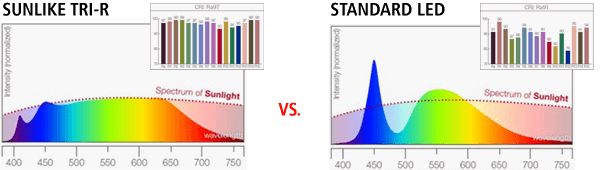
Conventional white LEDs use a blue emitting semiconductor chip. Only part of its light is converted into green and red by a phosphor layer; the unconverted blue remains in the spectrum as a narrow-band peak.
The TRI-R technology used in SunLike LEDs works with a violet emitting chip instead. Its radiation is fully converted into red, green and blue by a dedicated phosphor mix.
- No unconverted chip emission in the spectrum and therefore no dominant blue peak
- No pronounced gap in the cyan range around 480 to 500 nm
- The pump chip emits in the short-wave visible range (violet); for UV-sensitive applications, the short-wave limit of the spectral distribution in the datasheet is what counts
03
How do full spectrum LEDs differ from standard LEDs with CRI 80 or 90?
The difference lies less in the Ra value itself than in the shape of the spectrum. Standard LEDs achieve their Ra value across eight unsaturated test colours. Saturated colours, above all R9 (strong red), often drop off considerably.
- Standard LED, Ra 80: highest efficacy, R9 frequently below 20, clearly visible blue peak
- High-CRI LED, Ra 90: more red phosphor, but the blue peak remains
- Full spectrum LED, Ra 95 to 97: gap-free spectrum, high R9 and TM-30 values
In practice this means that skin tones, textiles, paint finishes, food and metal surfaces can be assessed in their true colour rather than merely illuminated adequately.

04
Which metrics should I consider besides the CRI value?
Ra alone describes the quality of a full spectrum only incompletely. The following metrics are also relevant for the design:
- R9 – rendering of saturated red, decisive for skin, wood, food and textiles
- TM-30-20 with Rf and Rg – colour fidelity and colour saturation across 99 test colours instead of eight; full spectrum LEDs typically reach Rf values above 90 with Rg close to 100. The values for the specific variant are given in the datasheet.
- CQS – additionally evaluates colour saturation and observer preference
- Chromaticity spread in SDCM or MacAdam ellipses – SunLike COB are binned to 3-step; relevant as soon as several light emitting surfaces are visible side by side
- Correlated colour temperature – SunLike LEDs are available from 2700 K to 6500 K
05
What efficiency penalty do full spectrum LEDs have?
A violet pump chip and full phosphor conversion mean a larger Stokes shift, that is more heat loss per lumen generated. Full spectrum LEDs therefore sit inherently below the luminous efficacy of high-efficiency Ra 80 types.
- 3030S-SunLike: approx. 104 to 139 lm/W
- 3030B-SunLike: approx. 95 to 111 lm/W
- MJT COB SunLike: approx. 81 to 109 lm/W
For the design this means: size the thermal management and the driver for the higher power demand if the same illuminance is to be achieved as with standard LEDs. Current values per part number are listed in the product table on this page.
06
Do full spectrum LEDs reduce the blue light content?
Not across the board – they distribute the short-wave content differently. The narrow-band peak around 450 nm is absent because no unconverted chip emission remains in the spectrum. How much blue radiation is emitted in total still depends on colour temperature and illuminance.
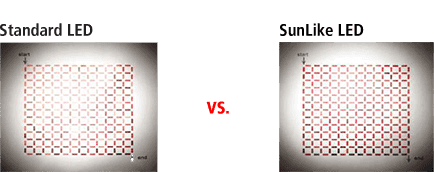
- Short-wave light is scattered more strongly within the eye. An even spectrum therefore appears higher in contrast and less glaring.
- Photobiological safety, that is the blue light hazard, must always be assessed on the finished luminaire in accordance with EN/IEC 62471 – not on the basis of the LED technology alone.
- The CIE points out in its position statement that blue light hazard exposure limits are similar for white light sources at comparable colour temperature, incandescent lamps included.
07
Are SunLike LEDs suitable for human centric lighting?
Yes, with one important qualification: the melanopic effect follows the sensitivity of the ipRGCs peaking around 490 nm and results from the entire spectrum. A missing blue peak alone does not make an LED melatonin-friendly.
- What matters is the melanopic daylight efficacy ratio (mel-DER) according to CIE S 026, not the course of individual peaks
- Time-of-day concepts require colour temperature and intensity control; SunLike LEDs cover 2700 K to 6500 K for this purpose
- Planning references are DIN SPEC 67600 and EN 12464-1
The actual advantage of the full spectrum is that the daylight-like spectral shape is retained across the entire colour temperature range.

08
In which applications are full spectrum LEDs worthwhile?
Wherever colour carries information or light acts on people over long periods:
- Quality assurance and visual inspection – colour deviations, surface defects and material transitions become visible without spectral gaps
- Medical technology and life science – assessment of skin tones, tissue and samples
- Museums, retail and hospitality – exhibits, goods and food in their original colour
- Offices, educational facilities and interiors – even light over long periods of use
- Horticultural lighting – the PAR range from 400 to 700 nm is covered continuously; for pure yield optimisation, however, dedicated horticulture LEDs are superior in µmol/J
Full spectrum LEDs are less worthwhile wherever only lumens per watt and lumens per euro count, for example in street, high-bay or emergency lighting.
09
Which SunLike package types are available and how do I choose the right one?
Three package families cover the majority of applications:
- 3030S-SunLike – mid-power SMD, 3 × 3 × 0.75 mm, variants around 0.2 W and 1 W, 120° beam angle, luminous efficacy up to approx. 139 lm/W
- 3030B-SunLike – SMD 3 × 3 × 0.6 mm with 3 V and 6 V variants (typically 65 mA and 150 mA respectively), 120° beam angle
- MJT COB SunLike – chip-on-board from 13.5 × 13.5 mm to 28 × 28 mm, 500 to over 4,000 lm, Vf approx. 35 V, 115° beam angle
As a rule of thumb: use mid-power LEDs for wide-area, low-glare lighting with many light points, and COB for directional lighting with reflector or lens optics, where a small, defined light emitting surface is required.
10
What should I consider when designing in full spectrum LEDs?
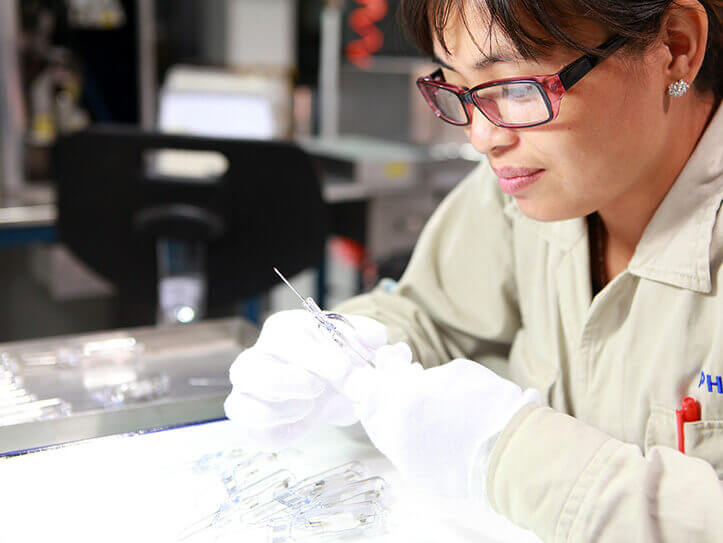
Full spectrum LEDs are used like high-quality standard LEDs, but because of their higher power dissipation per lumen they react more sensitively to tight thermal management.
- Junction temperature: Tj max. 125 °C; the design is based on the Tc measurement point defined in the datasheet, not on ambient temperature
- Thermal resistance: SunLike COB are around 0.7 K/W from junction to solder point – the heat sink determines luminous flux, chromaticity and lifetime
- Chromaticity stability: 3-step MacAdam ex works; drift over lifetime is phosphor-related and strongly temperature-dependent
- Lifetime: always derive L70 and L90 values from LM-80 measurement data with TM-21 extrapolation for the actual Tj and the actual drive current
- Driving: constant current operation; for dimming, PWM is preferable because the chromaticity remains stable across the dimming range
Services
We support you in every phase of your project. From the initial idea to series production, we accompany you with expertise, state-of-the-art technology, and customized solutions.

Why customers rely on us
For decades, we have been supporting our customers with tailor-made solutions, technical expertise, and personal service. This trust forms the basis for successful, long-term partnerships.
Customized solutions
Whether standard or custom solutions -
we deliver exactly what you need.
All in One
Distribution, development, production -
comprehensive service from a single source.
Innovative Technologies
Future technologies in use
for modern solutions with vision.
Personal project support
Reliable support right from the start -
on site, via call, or by phone.
Years of experience
Successful on the market since 1952
with in-depth industry expertise.
Network
Manufacturer expertise directly available
for development, innovation & optimization
Integration Level
High system integration with a concept
for efficiency and reduced complexity.
Technical expertise
Know-how and experience combined
for sustainable electronics solutions.
Sustainable
Responsible and resource-conscious
selection of components and supply chains.
Framework agreements
Predictable prices and supply -
tailored to your individual needs.
9001:2015
Certified processes for maximum
safety, quality, and compliance.
Logistics solutions
Kanban, consignment, min-max, and more
for availability and less inventory.
Customers who
trust us.
Latest News on Full Spectrum LEDs
Stay up to date with the latest product news, technical innovations, and trends in the field of Full Spectrum LEDs.


